
.jpg)
The economy grew at a four year low of 4.4 per cent in the April-June quarter of current year.

In her first address to a joint sitting of the two Houses in the new Parliament building in which she touched on varied issues ranging from insurgency to inflation, Murmu said a country can progress at a fast pace only when it defeats the challenges of the past and puts maximum energy into building the future.
Singling out India and China for the impressive growth in recent years, the Human Development Report-2003 of the United Nations Development Programme says bridging regional variations is a key challenge that confronts the two large economies.

'Even for operational buildings, we are looking to smarten them in various ways.'

''Even without major reforms, with a business as usual scenario, and with current inflation trends, we should be clocking around 11 to 12 per cent nominal growth.' 'That is not happening and is a source of worry,' Rathin Roy tells Arup Roychoudhury.

A V Rajwade wonders if the Modi sarkar is pursuing price stability at the cost of potential social instability in both rural and urban India.
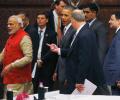
As per a PMO statement, Modi told the investors that "he believes in a fair, predictable and consistent tax system

Hailing India and the UAE as "partners in progress", Prime Minister Narendra Modi on Tuesday said the ties between the two countries serve as a model for the world and they are scripting a new history in the third decade of the 21st century.

The formula for success of farm economy is very simple -- farmers should be able to produce more from the same piece of land at reduced cost while minimising risk and be connected to market to get higher realisation for their produce, points out Siraj Chaudhry.
The banking sector in the country is stable, capital is available and credit offtake is poised to take off, he said at a webinar organised by Bharat Chamber of Commerce. "We are not unique to the phenomenon of uncertain growth and high inflation due to the pandemic.

Gen Z, don't shy away from expressing your ideas, and millennials, be receptive to new perspectives, suggests Sonica Aron, founder of the HR consultancy firm, Marching Sheep.

India, Asia's third-largest economy, is likely to grow 5.3 per cent in 2013, the OECD said, lower than the November forecast of 5.9 per cent.

Growth forecast has been lowered owing to tepid growth in the first half of 2017-18, the lingering effects of demonetisation, transitory challenges of GST, and some risks to agriculture stemming from a spotty monsoon.

The recent surge in crude oil prices could shave off the gains made by India Inc in profit margins in the past few quarters. Worse, it comes at a time when consumer demand in the country is slipping and major global economies are witnessing a slowdown. A back-of-the-envelope calculation suggests that the margin expansion accounted for three-fourths of the rise in the listed firms' operating profit between the April-June quarter (Q1) of FY23 and Q1FY24, and only a quarter of profits gains came from revenue growth.

A report stated that despite initial setbacks from demonetisation and Goods and Services Tax, "all in all" the Indian economy has done well.
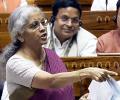
'Is the Agniveer scheme or their post-retirement re-employment in paramilitary forces or in the state governments the BJP's answer to the crying need on the job front?' 'Or, even Finance Minister Sitharaman's one-year internship scheme in the public and private sector, is it a permanent solution, either?', asks N Sathiya Moorthy.

RBI rate cut is a welcome step for all citizens of India as everyone is looking for near-term boost in economy.

The challenges before the coming Budget are more daunting than those in 2021, reveals A K Bhattacharya.

In 2013, India suffered its worst currency crisis in more than two decades but has regained the confidence of foreign investors in part after its current account deficit has narrowed sharply and its foreign exchange reserves hit a record high

'The current economic contraction is certainly due to the lockdowns as a response to the pandemic, which is an act of God.' 'Nobody has seen such a thing in the last 100 years.' 'Saying that this was an act of mismanagement is largely incorrect'

India must be prepared to deal with climate disasters, geopolitical confrontations, and social strife linked to global events, asserts Jayant Sinha, chairman of Parliament's Standing Committee on Finance.

The Budget oration of the finance minister and the confidence with which she delivered it, along with the measures and the recent upsurge in the economy would all contribute to unleashing the storied 'animal spirits' and help the economy run on the growth path quite smoothly. Or so the government hopes, notes Shreekant Sambrani.

The government's programmes should be expected to generate some momentum, but the macro-economic numbers are not encouraging, observes T N Ninan.

'As part of our D33 strategy, the plan is to establish 30 unicorns in Dubai within the next 10 years.'

If Saudi Arabia, with just two Muslim holy sites of Mecca and Medina, can create a huge tourism-based ecosystem beyond oil, Ayodhya is sure to become the world's hottest religious tourism site in less than a decade, predicts R Jagannathan.

This is the sixth of seven ships built under 'Project 17 Alpha' for the Navy. The first five ships of the project were launched between 2019 and 2022.

As more companies ask their employees to return to office after the pandemic, the share of women employed in regular salaried jobs in urban India decreased from 54 per cent in the first quarter to 52.8 per cent in the second quarter of the current financial year, according to the quarterly Periodic Labour Force Survey (PLFS) data. The slump in the share is the lowest in wage employment in any quarter in the last six years when the National Statistical Office started releasing the quarterly PLFS surveys in Q3 of FY19. The share of women in wage work was highest in Q1 of FY21 at 61.2 per cent.

The most immediate challenge for growth is the disruption of the global economy brought about by the Ukraine war and related sanctions, the Covid shutdowns in China and the rising tide of inflation, points out Nitin Desai.

The real requirement for the finance minister's explanatory speech is to explain the measures taken in the Budget to influence inflation and growth not just through the announcement of a deficit goal, but more broadly through the impact on money supply, consumer demand, foreign trade and investment, explains Nitin Desai.

Modi said there were a slew of 'matching priorities' between the business council and that of his administration, including dismantling trade barriers, promoting skills development, establishing manufacturing supply chains and infrastructure development.

The Congress on Sunday gave a call to party leaders in poll-bound states to work with unity to ensure victory that will 'set the tone' for 2024 Lok Sabha polls even as it showed willingness to forge an alliance of 'like-minded' parties.

'This is what happens to a party when it gets trapped in the vicious circle of nepotism and dynastic politics'

India has remained obsessed with cheap capital and infrastructure spending when instead the central constraint on Indian development remains the abysmal quality of Indians' skills, says Mihir Sharma.

'Last year, India exported more software than Saudi Arabia exported oil.' 'Last year India got $83 billion of private equity.' '50 percent of India's FDI has come in the last five years.'

To do so, the government will have to tackle a number of broad development challenges successfully, says Shankar Acharya

The boom in organised retail will set the tone for major economic overhaul. The ripple effect will be improved supply chains, volume output, integration into global commerce, and higher tax collection, notes T N Ninan.

For the banking system a new cycle starts in FY2024. It's fraught with fresh challenges on asset quality and profitability, warns Tamal Bandyopadhyay.

In the United States, economic data is likely to take a back seat next week.
